
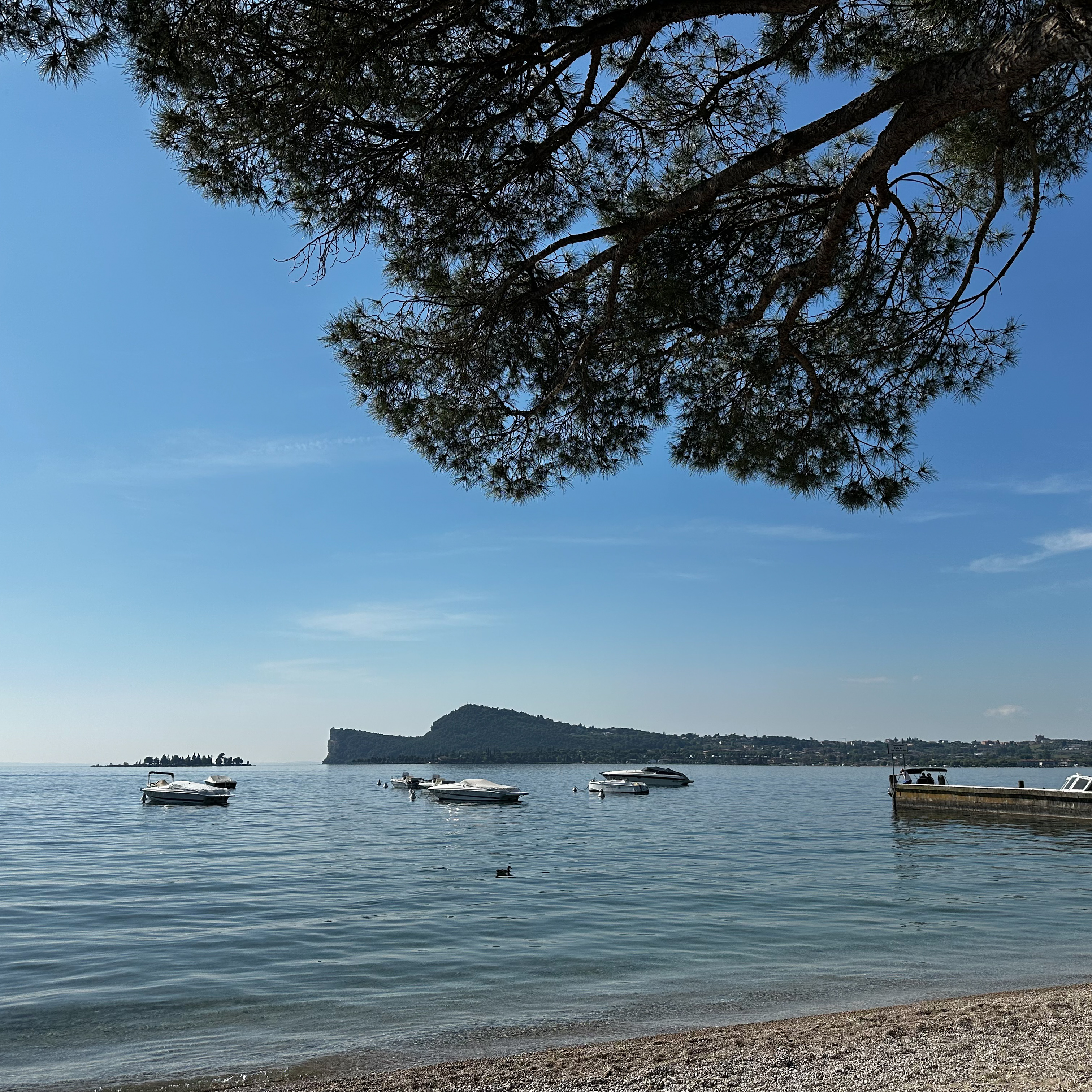
Manerba del Garda: Discover Cliffs, Beaches, and Wild Trails
Manerba del Garda, a village part of Valtenesi area, is a kind of patchwork of small rural places—Montinelle, Solarolo, Balbiana—spread across olive-covered hills and vineyard-lined backroads on the southwestern shore of Lake Garda. But what really defines this area is not its rooftops. It’s the land that drops suddenly towards the water.
Manerba’s heart is a natural reserve called ‘Parco della Rocca, del Sasso e Parco Lacuale di Manerba’ (Park of the Rocca, the Stone, the Lake Park) that protects over 110 hectares of land and, uniquely, 84 hectares of lake, with strict environmental rules normally found only in marine reserves. Boats with engines aren’t allowed near the cliffs. Fishing is heavily restricted. One entire stretch of water—classified as “Zone A”—is off-limits to all visitors except for scientific research. The goal is to protect wildlife and keep both the land and lake healthy.
In addition, the land is home to an astonishing 400 different plant species, including 21 varieties of wild orchids, some of which bloom only on these dry, sun-drenched cliffs.
🚫 Important to Know
In the most protected area (Zone A of the lake park), all bicycles and vehicles are strictly prohibited—even without engines.
The Rocca: A Fortress with a View

At the center of the reserve, the Rocca of Manerba rises sharply above the lake. From the top—216 meters above sea level—you can see the lake stretch in all directions. Below, the islands of San Biagio and Isola del Garda seem close enough to touch. On clear days, the view reaches as far as Sirmione and the Alps.

This limestone promontory used to have a strategic defense function. For centuries, it hosted a fortified village, traces of which are still visible today: stone walls, the base of a tower, and the remains of a medieval chapel. A metal cross marks the top now, and legends say a giant wolf once lived up here, defeated only when a local farmer used a cross to drive it over the edge.
Heading to the Rocca is an immersive experience in nature. My favourite time to climb there is early hours in the morning. Climbing up takes just 15–20 minutes from the car park, following a wide gravel path with wooden bridges. The trail is even lit in the evening, making sunset hikes a quiet local ritual.

Beaches in the Nature Reserve
Manerba has over 12 kilometers of shoreline, with beaches ranging from wild coves to small harbors. Here are three of the main access points to the lake within the reserve:
Dusano Beach
Located near the old harbor once used by local fishermen, Dusano has a quiet charm. Recently expanded, it offers a wide view across the lake—towards the Sirmione peninsula, Monte Baldo, and the Veronese mountains. Behind it rises a dramatic limestone wall, carved by the small Rio Morele waterfall. The beach faces southeast and is well-exposed to morning light. Just nearby, a scenic path begins, climbing along the rocky ridge to the top of Sasso, with panoramic openings that feel almost suspended above the lake.
Pisenze Beach
Located between the Rocca and the Island of San Biagio, this quiet beach is one of the most scenic and peaceful spots on Lake Garda. The water is crystal clear and fully protected— . Surrounded by nature, with only a small bar and restaurant nearby, it remains uncrowded even in summer. From here, walking paths lead up into the reserve, toward the Rocca or Punta Belvedere.
Rocca Beach
This is the most rough and natural beach in the reserve. Framed by steep cliffs and shaded by a high rock wall, it’s a small, narrow beach where the water turns deep just a few steps from shore. Thanks to the rocky lakebed, the water stays clear even in the middle of summer. Climbing routes run up the cliff behind it, and a small natural cave known as the “Büs de la Paùl” opens directly onto the beach. In summer, it’s sometimes accessible with CAI alpine guides (CAI is Italy’s national alpine association).
The Island with Two Names – Isola di San Biagio (or Rabbit’s Island)
Not far from Pisenze Beach, you’ll see a small green island just offshore. Officially, it’s called Isola di San Biagio, named after Saint Blaise. But around here, most people still call it Isola dei Conigli—the Rabbit’s Island. For years, wild rabbits lived here in the open grass and shrubs. Families loved spotting them on day trips, and the nickname stuck. Today the rabbits are fewer, but the name remains.
The best part? In summer, when water levels are low, you can walk to the island on foot, through a shallow stretch of lake passing through the camping village just next to it.
Sacred Places in the Landscape


Manerba’s hills and trails are dotted with small churches—some hidden, some still part of everyday life. The most evocative is San Giorgio, a simple stone chapel from the 16th century perched above the lake near Porto Dusano. Likely built as a funerary chapel for a local noble family, it is the oldest church in Manerba. Reached only on foot, it stands alone among olive trees, overlooking the water in silence.
Below the Rocca lie the remains of the Pieve di Santa Maria in Valtenesi, once the spiritual center of the area. Only part of the Romanesque structure survives, but it still speaks of centuries of rural faith. Not far from it, a small chapel called San Siro served as a cemetery oratory.
Today, the town’s main church is Santa Maria Assunta in Solarolo—built in the 18th century to replace the old pieve. Together, these sacred places trace a quiet spiritual geography across the landscape.

The Civic Museum of Manerba
Just below the Rocca, near the main entrance, is the Civic Archaeological Museum of Valtenesi. Small but rich in content, it tells the story of this land—from prehistoric tools to medieval ruins, Bronze Age settlements, and Roman finds.
One highlight: the story of San Sivino, a submerged stilt village from the Bronze Age, now part of a UNESCO heritage network. You can’t visit it directly, but the museum makes it visible through models and original artifacts.
There’s also a natural history section, with geological maps, local wildlife, and a model of the Büs de la Paùl, a mysterious natural sinkhole inside the park.
Events and Local Life
Manerba, throughout the year, becomes the stage for thoughtful events: open-air concerts, astronomy nights, historical reenactments, guided sunset walks, and environmental education days.
In September, there’s a medieval fair among the ruins, with artisans, archers, and musicians recreating the life of the ancient fortress. And each summer, Minerva Musicae brings jazz and classical performances to Manerba—an intimate concert series now in its fourth edition. Some concerts take place in unique locations, such as the Isola di San Biagio (Isola dei Conigli), offering attendees a truly immersive experience. You’ll also find wine tastings and small festivals in the villages around—but you’ll have to ask around or check the Visit Manerba website.
✨ Bonus Tip: Where to Stay
And if you’re staying the night, there’s a place in Manerba that’s hard to forget. Villa Schindler was once a countryside home from the late 1800s. It’s now a boutique hotel full of charm. The house looks out over the bay, with tall cypresses, olive trees, and a pool tucked into the garden. It feels like home. Breakfast is served on the terrace, with that kind of lake view that makes you slow down.