
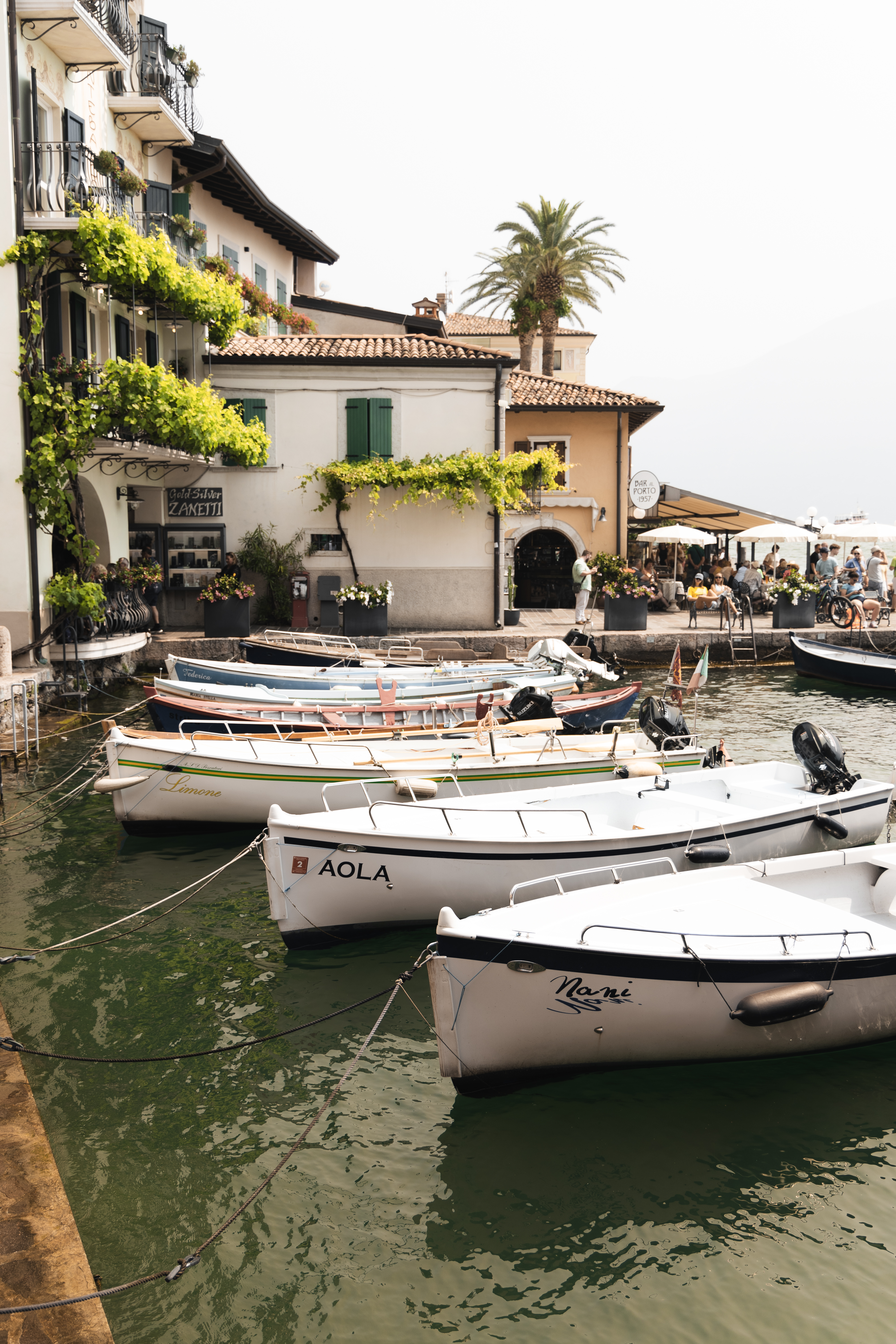
Limone sul Garda is one of those places whose name alone seems to tell you everything. But what many visitors don’t realise is that this small village, located just below the 46th parallel north, hosts the northernmost lemon groves in Europe ever cultivated on a commercial scale. But beyond the citrus trees and pastel houses, this lakeside village reveals a surprising mix of history — from trade and agriculture to long periods of geographic isolation and even a genetic anomaly that caught the attention of medical researchers.
From Fishing Village to Lemon Capital
Until the 17th century, Limone was a small community that relied on olive cultivation and fishing. Its remote location, set between steep cliffs and the lake, made it difficult to access — for centuries, it could only be reached by boat or mountain paths. That began to change in the 1600s, when several local families — especially the Bettoni counts — introduced citrus farming in a way not seen before this far north.
To grow lemons in a cold climate and on poor soil, residents built terraced gardens known as limonaie. These were complex constructions: white stone pillars supported wooden beams that held protective glass covers in winter. Soil was brought in by boat. Irrigation relied on carefully built canals. At its peak, Limone became the northernmost location in Europe where lemons were grown commercially.
What makes it even more unusual is the location: just below the 46th parallel north, Limone marks the northernmost point in Europe where lemons have been cultivated on a commercial scale.
The fruit — known for its thick rind and fragrant juice — was shipped as far as Austria, Poland, and Russia. Today, one of the few remaining limonaie, the Limonaia del Castèl, has been restored and is open to the public. La Limonaia del Castèl opens to the public at an entry fee of €2, with free admission for children under 10. Look out for evening openings during the summer season (June 1 to September 30), until 10 PM.

Isolation, Decline, and Reinvention
By the late 19th century, lemon cultivation was in decline. A plant disease in 1855 destroyed many trees, and after Italian unification, lemons grown in southern Italy became cheaper and more widely available. The discovery of synthetic citric acid marked the final blow. Most lemon gardens were abandoned. Some families returned to traditional lake fishing and olive oil production, forming a local cooperative in 1919.
Until the 1930s, Limone was hard to reach. The only way in was by boat or on foot along steep mountain trails. That changed in 1932 with the construction of the Western Gardesana Road. Carved directly into the rock — much of it still the same today — the road finally connected Limone with Riva del Garda and Gargnano. For the first time, visitors could arrive by car.
Tourism followed. Travellers from Germany and Austria were among the first to come, drawn by the climate and the image of a “lemon village.” Locals adapted quickly. Guesthouses became hotels, and the economy shifted towards tourism. In recent years, some of the historic limonaie have been restored for cultural and educational use.


The Name, the Legend, and the Fruit
Despite the name, Limone probably isn’t named after its lemons. One theory traces it to lìmen, Latin for “border,” as this area marked the edge of various territories throughout history. Another theory links it to a Celtic word for elm.
Still, the connection to citrus is strong. A local legend explains it in mythological terms: Limone was the name of a young hunter, son of the lake god Benaco, who was killed and later brought back to life with a magical potion. He then settled in the sheltered bay and began cultivating the fruit that would carry his name.


Between Science, Literature, and the Landscape
In 1979, a man from Limone walked into a hospital in Milan. His cholesterol was off the charts — but his arteries were perfectly healthy. The anomaly puzzled doctors, who ordered further tests. What they found was unusual: a previously unknown blood protein that seemed to protect the cardiovascular system.
Later studies confirmed the presence of this rare mutation in several families from Limone, all descended from a couple who had lived there in the 1600s. The protein was eventually named Apolipoprotein A-1 Milano, after the city where it was identified. The discovery attracted international attention, as researchers explored how it might inspire new treatments for heart disease. In Limone, the story became part of local history — and is still told today at the town’s small Museo del Turismo.
But curiosity about Limone didn’t begin with science. In 1786, Goethe passed through by boat and wrote about its terraced lemon gardens. A century later, D.H. Lawrence noted the surreal sight of citrus trees growing near the Alps. Their words helped shape how northern European travellers imagined this stretch of Lake Garda — not just as a scenic stop, but as a place of resilience, ingenuity, and contrast.
Why It Stands Out
Limone’s identity rests on a few rare, tangible features: terraced citrus gardens unlike anywhere else on Lake Garda, a mild microclimate where olive trees and palms grow beneath alpine cliffs, and a village shaped by the need to use every inch of land between mountain and lake.
The streets are narrow, often stepped, layered out of necessity rather than design. Many houses still carry signs of the past — a small lemon tree in a courtyard, an olive press set in stone, or an old fishing net drying in the sun. Everyday life and memory still overlap here.
It’s also one of the best places on the lake for walking. A network of panoramic trails begins just outside the village, offering views of the cliffs, the water and the terraced gardens from above.
👉 Read: Panoramic Walks Around Limone
Leave a Reply